




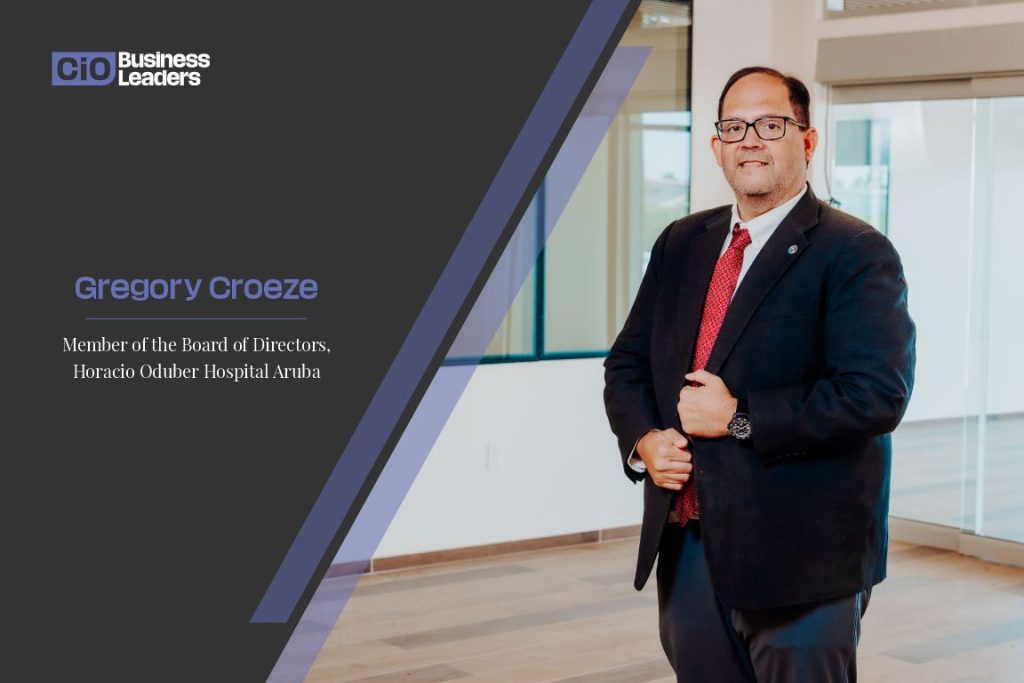
As a member of the Board of Directors at Horacio Oduber Hospital (HOH) in Aruba, Gregory Croeze brings together business acumen, empathy, and a deep sense of purpose. With a background in finance and consulting, he has helped guide the hospital through complex challenges while fostering innovation, collaboration, and a culture rooted in care. In this interview with CIO Business Leaders Magazine, Gregory reflects on his journey, the lessons he has learned in leadership, and his vision for the future of healthcare on the island.
Journey into Healthcare
Gregory originally had no plans to pursue a career in healthcare. When he was completing his MBA at the University of Central Florida, he focused on building a strong business foundation that would lead to a management role and eventually a leadership position.
“My journey into the healthcare sector began unexpectedly, as a finance manager for a clinic, and evolved over time into a board of directors role at HOH Aruba,” he says.
Gregory’s motivation to continue working in this field stemmed from his curiosity and a genuine desire to make a difference. According to him, he has always been driven by learning and growth, and healthcare constantly challenges one to adapt, innovate, and serve. He found the sector’s ever-evolving nature, coupled with the opportunity to contribute to others’ well-being, a perfect fit for his passion, curiosity, and sense of purpose.
Background in Finance and Consulting
Gregory’s background in finance and consulting has shaped his decision-making approach at Horacio Oduber Hospital. Before making any decision, he gains a clear understanding of its financial implications. This ensures that their choices are sustainable and aligned with the organization’s long-term strategies and goals. However, he recognizes that effective leadership is not all about numbers in healthcare.
“Finance gave me a strong analytical foundation, but healthcare taught me to balance data with empathy,” Gregory says. “Not every return on investment can be measured in dollars; sometimes, it’s reflected in the quality of life we help deliver to our patients.” This perspective has allowed him to blend strategic, value-driven thinking with a clear understanding of the human side of their mission.
Responsible for Core Operational Areas
As a member of the Board of Directors, Gregory is part of a team working toward one common goal: ensuring that the hospital operates safely, efficiently, and always in service of patient care. Their vision is “accessible healthcare for anyone, without compromising on quality”. According to Gregory, his role focuses on the core operational areas that support the care they provide.
He oversees multiple departments, including human resources, IT, finance, data management, maintenance, medical electronics, bookkeeping, purchasing, logistics, and medical documentation. He makes sure their doctors and nurses have the tools, equipment, and infrastructure they need to deliver excellent care. That means ensuring their IT systems are secure and reliable, their equipment is properly calibrated, and their facilities are well maintained. He ensures that their teams, from kitchen staff to security, have what they need to perform at the highest standard. Financially, it also means maintaining accurate reporting, ensuring healthy cash flow, and keeping their operations sustainable.
“In short, I make sure ‘the lights stay on’, literally and figuratively, so our caregivers can focus on the patients,” he says.
Gregory does not prioritize one responsibility over another. He says that running a high-quality, safe hospital requires every part of the organization to function in harmony. “While each board member has a specific area of focus,” he adds, “we share collective responsibility for the hospital’s overall success and stability.”
Leadership in Hospitals like HOH
Leadership in a hospital that serves a diverse island community like Aruba carries a special kind of responsibility. As one of the faces of HOH, Gregory has to be present, listen, and represent the hospital at many events across the island.
He says that their vision is to provide accessible, high-quality healthcare for everyone, without exception. They welcome every patient, regardless of background, ethnicity, age, gender, or circumstance. Gregory notes that in Aruba, nearly half of the population has roots in other countries, and most people speak four languages fluently. That diversity is reflected within HOH’s workforce as well, with more than 30 nationalities represented at the hospital.
“For me, leadership in this context means recognizing and respecting that diversity- understanding the different cultures, histories, and perspectives that shape our patients and our staff,” Gregory says. “It’s about creating an environment where everyone feels seen, valued, included, and cared for, so that we can serve our community with empathy and unity.”
The Initiative: HBOT
In 2026, a hyperbaric oxygen therapy (HBOT) chamber is set to be introduced. Gregory calls it one of their most defining initiatives, as it will have an immediate and meaningful impact on patient care. Aruba currently does not have this capability, even though chronic wound issues, especially those related to diabetes, are a significant concern on the island.
The HBOT chamber is expected to dramatically improve patients’ quality of life. Gregory says it will accelerate healing and help prevent amputations, at least at an early stage. It will also enable the hospital to provide specialized care locally, reducing the need for patients to travel abroad for treatment. Additionally, it positions Aruba to support dive-related medicine, opening opportunities to serve residents and visitors more effectively.
“Our goal is to integrate the HBOT chamber with our Center for Advanced Wound Care,” Gregory says. “It will create a center of excellence that combines technology, expertise, and compassion, improving outcomes for our patients and strengthening healthcare standards across the island.”
The Challenge: Decisions Involving Human Lives
In his six years at HOH, Gregory has faced challenges spanning every aspect of leadership, including clinical care, innovation, finance, operations, and even political and social dimensions.” However, for him, the most difficult decisions are those that involve human lives.
“One of the toughest choices I’ve had to make was whether to move into a newly built sterilization department that was not yet fully up to standard,” Gregory shares. On one hand, their old facility had serious limitations and safety concerns; on the other hand, the new one, though modern and promising, still had gaps that needed to be addressed. Gregory says that it felt like choosing between two imperfect options. Ultimately, they decided to move forward with the new facility after weighing the risks and committing to fixing the outstanding issues along the way.
“That experience reinforced a key lesson for me,” Gregory says, “leadership often means making difficult decisions with incomplete information.” He learned that leaders should assess the risks, consult with the right people, and sometimes take a calculated leap, always with patient safety and organizational integrity as their compass.
Building a Culture of Collaboration
Departments often tend to work in silos, focusing on their own areas. So, it is a challenge to build a culture of collaboration in a hospital. “Healthy competition can be beneficial,” Gregory points out, “but we have to avoid becoming ‘islands’ within the organization.”
To encourage collaboration, they ensure different departments are represented in various committees, where their voices can be heard and their expertise shared. For example, the investment committee comprises representatives from across the hospital. Gregory says that this committee plays a crucial role in evaluating priorities and making recommendations to the Board of Directors. It ensures that decisions, such as whether to invest in new technologies, are balanced with the hospital’s essential operational needs. Gregory explains that, for instance, there is no need to pursue robotic surgery if ultrasound equipment needs to be replaced. Through this structure, they make decisions collectively, and everyone feels ownership over the direction they take.
Compared to collaboration between departments, collaboration with external stakeholders can be more complex, as not everyone shares the same vision or objectives. “Maintaining open communication and staying informed about what is happening outside our organization helps us anticipate challenges and prepare strategically for the future,” Gregory says.
Balancing: Excellent Patient Care with Financial Sustainability
Balancing patient care excellence with financial sustainability is at the heart of every decision Gregory and his team make. They constantly strive to provide the highest quality care, but their financial and logistical realities of operating on a small island pose unique challenges. Gregory says that there are certain procedures or treatments they cannot offer locally due to limited resources, specialized equipment, or available expertise.
In the past, this meant sending patients abroad for certain procedures. Recently, they have adopted a more creative approach. According to Gregory, they bring medical specialists to Aruba to perform specific treatments in scheduled “bundles”. This reduces costs as well as improves the overall patient experience.
“Every decision we make involves this kind of balance- assessing what is financially viable while ensuring we never compromise the quality or humanity of care,” Gregory says. Some subspecialities are so rare that it is not feasible to have them permanently on the island, but wherever possible, they find innovative ways to deliver excellent care within their means.
Achievements: Professional and Personal
Gregory has many achievements to celebrate, both professionally and personally. As a professional, he takes great pride in the progress they have made in improving employee satisfaction at HOH over the past few years. It took a series of efforts, rather than a single decision, to achieve this improvement. “We consistently put our people first,” Gregory says.
Other factors that contributed to that success include building trust between the staff and the Board of Directors, negotiating fair collective labor agreements, and fostering open communication. “Seeing the trust reflected in our employee feedback is one of the most rewarding outcomes of my career,” Gregory says. “As my colleagues always say, ‘happy employees lead to satisfied customers.’”
Personally, he is most proud of the father he has become. Despite his demanding work schedule, he tries to be present for his two children. He not only guides them but also gives them the freedom to grow into who they are meant to be. “Watching them evolve, learn, and find joy in the world is an incredible blessing and a daily reminder of what truly matters,” says Gregory.
Future of Healthcare and HOH’s Vision
Gregory notes that healthcare and hospitals are changing faster than ever before. Traditionally, hospitals have been the central point of care, but he believes the future will bring a shift toward more decentralized and personalized care models.
Advancements in technology and artificial intelligence will lead to many aspects of treatment and monitoring increasingly taking place outside hospital walls, even in patients’ homes, according to Gregory. He also sees remote consultations, wearable health devices, and data-driven diagnostics making it possible to deliver high-quality care wherever the patient is.
“That said, hospitals will always play a vital role,” he underscores. “Babies will still be born in maternity wards, intensive care units will remain essential for critical patients, and emergency and surgical services will continue to be the backbone of acute care.” He expects integration of technology, data, and human connection, ensuring that even as medicine becomes more digital, it never loses its heart.
Gregory’s vision for HOH is to continue evolving into a smart, compassionate hospital. He wants it to embrace innovation yet remain grounded in its mission to serve the people of Aruba with excellence and empathy.
Work-Life Balance
When Gregory accepted his current position, he knew it would not be a traditional nine-to-five job. He understood the demanding nature of his role.
“Being ultimately responsible for a hospital is both an honor and a constant responsibility,” he says. “Therefore, it’s essential to have strong managers and leaders you can truly rely on — people who are well-prepared, well-trained, and equipped to make good decisions.”
Gregory explains that delegation is an art, and a successful leader knows when to delegate and when to stay closely involved.
Personally, he makes a conscious effort to disconnect from work and focus on his family. He, however, admits that it does not always happen. He is the father of a five-year-old daughter who is full of energy and a newborn son who keeps them on their toes. Fortunately, his wife understands the demands of his role. She gives him the space to recharge, whether that is spending quiet time together or watching sports on TV. They make it a point to travel at least once a year, often to Disney, where they can enjoy being a family. “Such moments help me reset and return to work with a renewed focus and perspective,” Gregory says.
Advice for Aspiring Leaders
Gregory believes that healthcare leadership is not for the faint of heart. He considers it one of the most fulfilling paths one can take. Leading in healthcare, he says, offers the unique opportunity to make decisions that directly improve people’s lives, both patients and those who care for them.
Gregory advises young professionals to stay curious, keep learning, and never lose sight of why they started in healthcare. “If your motivation is to help others and make a difference, the challenges will be worth it every single day,” he adds.