




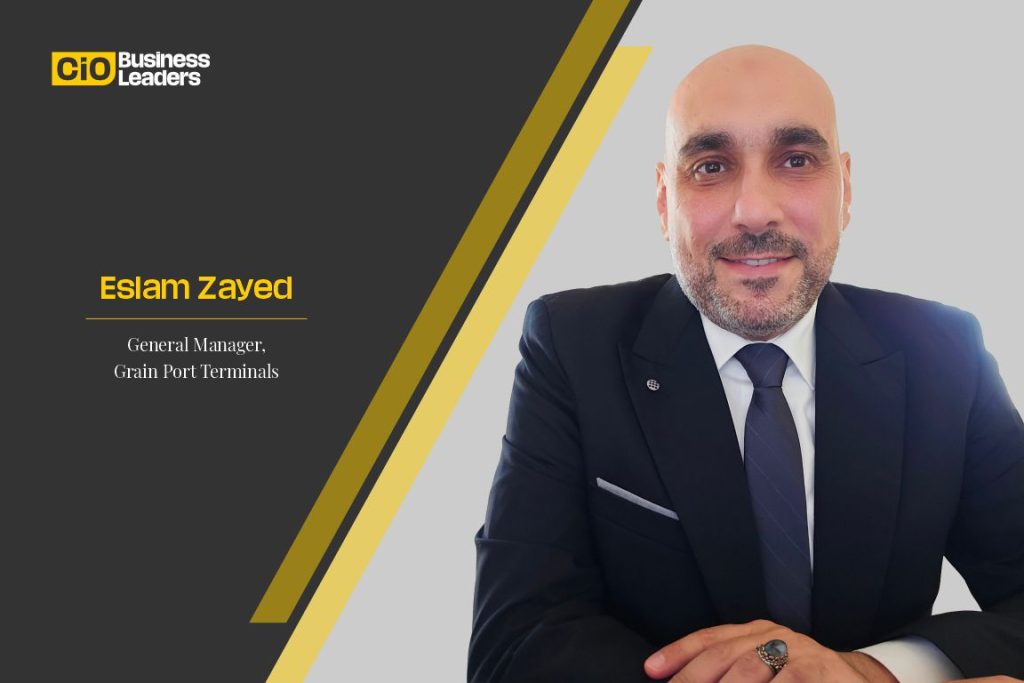
For Eslam Zayed, efficient grain management carries an altruistic connotation. He believes it is a service to society and food security. So, as Port Terminal General Manager for one of the strategic grain-port-terminals in KSA, he is playing a pivotal role in national food security and global trade resilience, in addition to setting new standards of operational excellence.
Beginning in Grain and Logistics Industry
“Efficient grain logistics is not just business — it’s a service to society and food security.”
Eslam’s conviction that food security is one of the cornerstones of social and economic stability set him on a professional journey in the grain and logistics industry. At the beginning of his career, he was fascinated by the challenge of building a safety culture alongside an efficient operation. He was curious about how to ensure his team returned home safely, in addition to running the grain business efficiently to make an impact, stabilize markets, and ensure that communities have reliable access to food.
“This sense of purpose drove me to explore the technical, operational, and strategic dimensions of the industry,” Eslam says. Over time, he realized that efficient logistics require strong leadership that can keep people safe and aligned under pressure, not just a focus on infrastructure and systems.
According to him, the opportunity to lead at the terminal level came as a natural progression, allowing him to merge operational expertise with a broader vision. “Today, I see my role as not just managing a facility, but as serving an ecosystem that contributes directly to national food security and global trade resilience,” Eslam says.
Tackling a Major Challenge
“In a crisis, leadership is less about control and more about clarity and composure.”
One major challenge Eslam and his team faced was when a supply chain disruption created downstream pressure on their clients. Eslam says that this was due to a major failure in a terminal, which resulted in delayed vessel schedules. In addition to rapid response, the situation demanded team alignment.
“I tackled it through transparent communication,” Eslam says. He explained the reality, set clear priorities, and divided responsibilities so that everyone knew where to focus. “We celebrated small wins as we regained control, which kept morale high during an intense period,” he recalls. Soon, they were able to resolve the disruption with minimal impact.
For Eslam, the experience underscored a key lesson: “During crises, people look to their leader for clarity and composure.” According to him, his role was not to solve every problem himself, but to create the environment where the team could perform under pressure.
Establishing a Journey of Operational Excellence
“A leader’s role is not just to deliver results, but to inspire confidence in ambitious goals.”
When Eslam got the opportunity to lead the operations for a strategic region, he established a world-class journey in operation excellence at a grain port terminal in MEA region. He looks back at this achievement with great pride.
Eslam’s team achieved 95% availability with 90% efficiency. They enabled the port terminal to handle +2.4 million tons of grains, which was a sharp increase from 0.9 million tons in previous years. Operating costs also reduced by 48%. “Equally important was the focus on human capital,” Eslam says. “I worked with the team to enhance workplace well-being, which raised the employee engagement index to 88%, which was up from 40–60% in earlier years.”
Additionally, Eslam empowered women in operations. Under his leadership, female representation increased to 6% from 0%, including in supervisory roles. It established a culture of diversity, equity, and inclusion in the organization.
“This experience taught me that leadership is less about directing tasks and more about inspiring confidence, especially when goals appear ambitious,” Eslam says.
Ensuring Operational Excellence
“Excellence is a culture — when people own safety, efficiency, and sustainability as part of their purpose.”
“Excellence is cultural,” Eslam says. He believes companies with a culture of discipline and consistency achieve operational excellence. He explains that when every team member knows that their role contributes to reliability and food security, excellence becomes a natural standard, not an exception.
Eslam and his team also focus on these three pillars for sustained excellence: safety, efficiency, and sustainability. “Safety is non-negotiable,” Eslam says. “It is embedded into daily routines, training, and decision-making.”
They ensure efficiency through rigorous monitoring of performance indicators and continuous process improvement. And sustainability is a core aspect of their guiding principle. So, energy optimization, waste reduction, and investment in long-term resilience are an integral part of Eslam’s strategy.
“These three pillars are supported by regular audits, digital monitoring, and open feedback channels,” he says.
Principles Guiding Leadership
“In disruption, my compass is clarity, calmness, and communication.”
Whenever Eslam is in a high-pressure situation, he leverages these three leadership principles: clarity, calmness, and communication.
For him, clarity means defining the problem quickly and setting immediate priorities. Calmness is staying composed, he says, because panic spreads faster than facts. And communication is keeping both internal and external stakeholders aligned so that decisions are executed without confusion. Eslam says that these principles ensure that decisions are timely and grounded in logic and trust.
He also believes in learning after a hurdle is crossed. “Once a disruption is resolved, I review the decisions with the team to extract lessons for the future,” Eslam says. “In this way, every challenge becomes a stepping stone toward greater resilience.”
Allowing People to Take Ownership
“Empowerment is giving people clarity, trust, and the ownership to lead at every level.”
Eslam describes empowerment in leadership as enabling people to take ownership of outcomes, and providing them with the clarity, tools, and trust they need to succeed. He says that no leader can control every detail of a complex environment, which makes empowerment crucial when overseeing a large-scale terminals operation. And, according to him, success also depends on developing leaders at every level who feel confident to make informed, safe-operation decisions.
And empowerment comes with accountability. Eslam explains that it is about balancing autonomy with clear expectations and measurable results. “When people feel trusted and supported, they bring out their best,” Eslam says. “That collective energy is what drives both operational excellence and innovation.”
Culture of Accountability and Innovation
“Accountability keeps us grounded; innovation pushes us forward.”
Eslam does not see accountability and innovation as opposites. He believes they thrive together when guided by trust. He says that accountability starts with clear goals and transparent performance measures, so that individuals understand both their responsibilities and the impact of their work.
Innovation, on the other hand, grows when people feel safe to challenge old methods, practices, and share ideas without fear of failure. Eslam considers both responsible execution and creative problem-solving important. He points out that by balancing discipline with openness, the team knows meeting targets is essential, but finding smarter ways to meet them is equally valued. “Over time, this dual culture creates a workforce that is not only reliable but also forward-thinking,” Eslam says.
Technology Redefining Terminals Operations & Supply Chain Management
“Technology should not replace people — it should empower them.”
Eslam notes that technology is defining the way one thinks about terminal operations and supply chain. AI and advanced data analytics are enabling their transition from reactive to predictive management. “Predictive maintenance reduces downtime, while digital platforms provide real-time visibility,” Eslam says. He also points out that automation is improving efficiency and safety, and energy optimization tools are enhancing sustainability.
He, however, does not believe that technology will replace people. He is a proponent of leveraging technology to empower people. “The real transformation comes when technology enables smarter decisions, faster responses, and safer operations, freeing people to focus on higher-value tasks,” Eslam says. “The future will belong to organizations that embrace this human-technology partnership.”
Lessons Gained from Experiences in Multiple Countries
“People Call it Africa. I Call it Home.”
Eslam’s professional journey has taken him to several countries across Africa. His experiences in each have made him appreciate more the cultural and operational diversity. He notes that every country has its own business environment, regulatory framework, infrastructure, and workforce dynamics. To deal with these differences effectively, he believes agile strategies and a tailored approach are required. “Navigating these differences has strengthened my adaptability and resilience as a leader,” Eslam says.
His experiences have taught him to listen first, because what works in one context may not translate directly to another. He has learned to actively engage with local teams, whose invaluable insights often lead to innovative and practical solutions. Eslam says that his leadership capabilities have sharpened as well. He can now effectively align global strategies with local realities, along with ensuring efficiency and safety standards are consistently upheld.
“My experiences allowed me to develop strong cross-border coordination skills, ensuring that regional objectives are met while respecting local conditions,” Eslam says. “It also reinforced my belief that sustainable success comes from blending global best practices with local strengths.” And values such as inclusivity and respect are now an integral part of his leadership approach.
Eslam points out that bringing together perspectives from different backgrounds not only enriches decision-making but also builds trust and stronger collaboration across borders.
Accelerating Digital Integration in the Middle East
“The Middle East’s next leap in logistics will come from digital integration and connectivity.”
If Eslam had the opportunity to drive one major change in the Middle East’s logistics and grain handling sector, he would focus on accelerating digital integration across the entire logistics ecosystem. The region has seen heavy investments in infrastructure, but Eslam notes that there is still tremendous potential to unify data platforms, enable real-time visibility, and connect stakeholders seamlessly.
He believes digital integration will reduce inefficiencies, improve transparency, and strengthen resilience against disruptions in the region. He also expects it to position the Middle East as a global logistics hub because of its smart, connected, and agile systems. “In a sector that underpins food security, this transformation would be both strategic and urgent,” Eslam points out.
A Leader’s Typical Day
“Leadership means balancing today’s challenges with tomorrow’s opportunities.”
Eslam usually starts his day by reviewing operational performance, safety indicators, and any immediate challenges faced by the team. “Being visible and engaged in daily operations helps me stay connected to realities on the ground,” he says.
Once that clarity is established, he shifts his focus to the strategic side. He analyzes performance trends, discusses growth opportunities, meets with partners, and plans for future capacity and technology adoption. Eslam says that to balance these demands, structured prioritization is needed.
He often asks himself: “Will this decision only solve today’s issue?”, or “will it strengthen our operations tomorrow?” The answers to these questions allow him to position the terminals and the supply chain for long-term resilience, instead of engaging in frequent firefighting.
“In essence, my role is about switching fluidly between the tactical and the strategic approaches while keeping both aligned to a single vision,” Eslam says.
Work-Life Balance in Demanding Logistics Environment
“Well-being is not separate from leadership — it fuels it.“
Eslam considers discipline and focus critical for balancing a demanding role with personal well-being. He views personal health, family, and reflection as investments in his performance, not distractions from it. For him, family commitments are usually non-negotiable. “I carve out time for my family, my friends, me-time and rest,” Eslam says.
At work, he delegates effectively and empowers his team so that responsibility is shared rather than concentrated. He explains that this balance is essential because leadership requires clarity of thought and emotional energy, neither of which is possible without personal well-being. “By modeling this balance,” Eslam says, “I also encourage my team to prioritize their own health, which ultimately makes the entire organization more sustainable.”
Special Shoutout to Wife and Mentor
“No man succeeds without a good woman behind him.”
Eslam says that his wife’s support, patience, and belief in his abilities have motivated him to overcome challenges and pursue growth with confidence. “Throughout my professional journey,” Eslam says, “my wife has been my constant source of strength and balance. She has not only been a partner in life but also a quiet force behind every milestone.”
Eslam also remembers his late mentor,” Bill Waddy. “There are special people in our lives who never leave us, even after they are gone,” he says. Bill’s wisdom and character have left a lasting mark on Eslam’s career and life. Bill was more than a professional guide—he was a true friend.
“Through his encouragement and belief in my potential, he helped shape my professional path and inspired me to lead with purpose and compassion,” Eslam says. “His memory continues to influence my decisions and reminds me daily of the power of genuine mentorship and friendship.”
Advice for Aspiring Leaders
“Leadership is not about authority — it’s about responsibility.”
Eslam advises young professionals to stay curious, remain resilient, and build meaningful relationships. As the logistics and agribusiness sectors are dynamic and unpredictable, it is the ability to adapt, learn quickly, and collaborate that sets young professionals apart, according to him.
He encourages young professionals to seek mentors, embrace challenges, and go for frontline experience, where the most valuable leadership lessons are learned. “Finally, remember that leadership is not about authority; it’s about responsibility,” Eslam says. “If you focus on adding value, supporting your team, and acting with integrity, leadership opportunities will naturally find you.”