




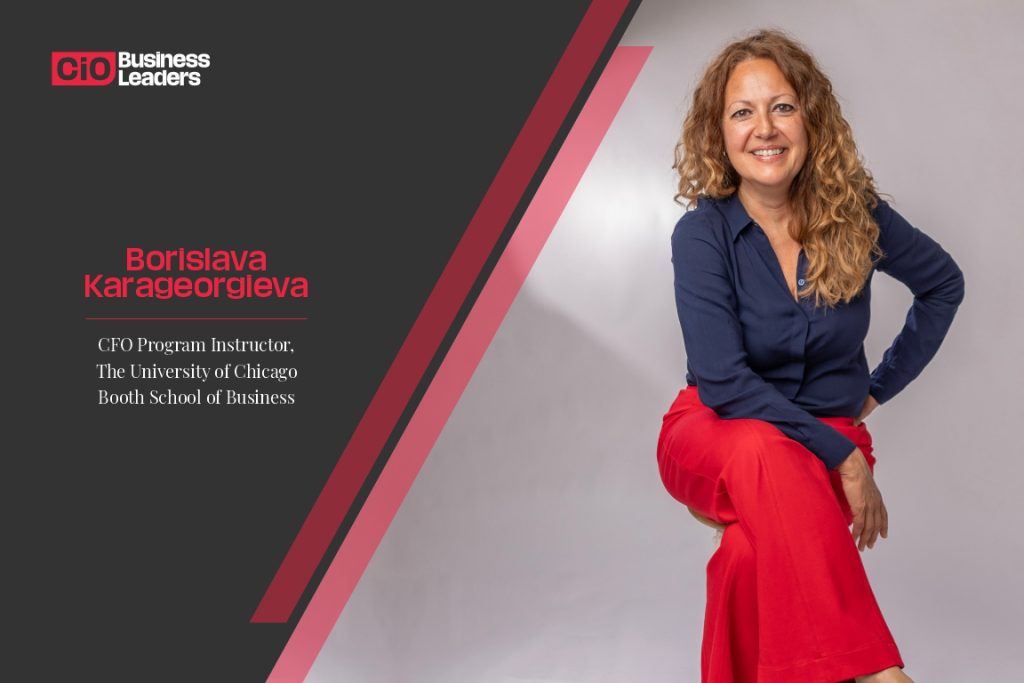
Teaching has never been a part of my original career plan but it has turned out to be one of the most meaningful and rewarding career choices of my professional life. What began as an extension of my work in corporate financial strategy evolved into an opportunity to help finance leaders make better decisions by translating financial complexity into clear, practical insight. It also keeps me deeply engaged with the evolving challenges CFOs face. I see teaching not as a departure from my career but as a natural continuation of it – one that allows me to multiply my impact by shaping how leaders think, decide, and lead- says Borislava Karageorgieva, the CFO Program Instructor and Certificate Coordinator at The University of Chicago Booth School of Business.
Borislava is a strategic finance leader who has operated through complexity, disruption, and transformation and who now helps organizations and executives make better financial decisions in times of growth, uncertainty, and change. In her journey, disruption was never the end of the story; it was the trigger for transformation and the invitation to innovate. Repeated disruption became a catalyst for transformation, and each transformation required innovation; creating new paths across countries, business, public service, entrepreneurship, and education.
Growing up in Sofia, Bulgaria during the country’s transition from a planned economy to a market-based one deeply influenced how she thinks about transformation. Watching businesses have to fundamentally change the way they operated in order to compete in a globalized economy showed her that transformation is not optional—it is essential for survival and growth.
As Borislava Karageorgieva describes, globalization and competition became the defining forces of that period, and companies had to rethink their business models to become internationally competitive. Seeing that kind of large-scale economic and organizational reinvention shaped her view of transformation as a process of adaptation, value creation, and strategic change rather than simply change for its own sake. That evolution taught her early that systems are not fixed but can evolve. And such transformation is unpredictable, risky, and rarely moves in a straight line. Witnessing these changes firsthand showed her how new opportunities further accelerate change, while highlighting how different generations perceive and experience these disruptions in distinct ways.
Each major disruption in Borislava’s life forced a transformation, and each transformation required innovation. After graduating college, she moved to the USA where she pursued an MBA at the top-ranked University of Chicago, a long-held top choice. Choosing to applying as a local student opened up expanded options for schools and financial support compared to international routes. She handled a rigorous admissions process and funded her studies by working while enrolled, proving that setting a clear goal and remaining insistent form the foundation of success. An effective work-study system meant creating a disciplined structure in which employment and education reinforced one another. By working while enrolled, she developed a practical way to fund tuition and living expenses, manage budget responsibly, and maintaining financial independence without losing sight of academic priorities. Persisting through these obstacles strengthened her resolve, inculcating the confidence and resilience that continue to outline her personal and professional growth today.
When asked what sparked her focus on corporate finance, she answers directly: “I have always been fascinated by how companies make strategic decisions, how they allocate capital, manage risk, and shape their future.” That fascination was sharpened by watching companies transform during Bulgaria’s transition to a market economy, when businesses had to abandon inherited structures and learn how to survive through discipline, adaptation, and strategic financial decision-making. In that environment, capital allocation, risk management, and long-term planning became not just business functions, but conditions for survival. As she notes in her article, ‘Blueprint for Thriving Companies’ (UCPE, 2023), understanding how companies actually operate became a way of understanding how they endure change and create value. That early exposure is why her insights into corporate finance continue to resonate with clarity and relevance.
Known for reinventing, adapting, and excelling, Borislava has built a career defined by repeated disruption and deliberate transformation. From leaving Bulgaria and arriving alone in the U.S., to overcoming financial and institutional barriers to education, working two jobs at times, changing industries and roles, relocating internationally for a major position, navigating motherhood’s impact on her personal and professional choices, and rebuilding again in the U.S., she has repeatedly faced structural disruptions to her plans, identity, geography, and career trajectory. Each time, she turned uncertainty into opportunity. Ignited by a solid inclination to evolve, her course covers corporate financial strategy for companies across the lifecycle spectrum – from early-stage to mature companies.
In this exclusive interview, Borislava shares the key turning points of her professional journey – mirroring the principles of corporate financial strategy: assessing uncertainty, allocating resources carefully, managing risk, adapting to disruption, and creating value through disciplined decisions. That is why she teaches the subject not only as theory, but as a practical framework for leadership and growth – and reveals what makes her corporate strategic work unique.
Where Learning Meets Real Impact
She saw from the outset that teaching was one way to influence how financial leaders think and act when the stakes are high. Joining the Strategic Management Certificate Program at the University of Chicago Professional Education in 2000 gave her the ideal platform to translate theory into practice. She quickly recognized that her impact could grow by equipping financial leaders with practical frameworks, analytical tools, and a mindset rooted in peer-based discussions. In her words: “I designed and delivered two courses for the program and found it deeply rewarding to work with business leaders from across the globe, including the United States, Brazil, Portugal, Spain, and Mexico.” The experience has been very much a two-way exchange in which I share my expertise while also learning from the perspectives, challenges, and insights that executives bring to the classroom.”
She later expanded her purview, transitioning into teaching in the Chief Financial Officer Program, where she also serves as Certificate Coordinator. As the program’s reach has continued to expand, it is welcoming participants from the United States, Australia, Hong Kong, Mexico, and Brazil. This ongoing international engagement has enriched her teaching skills and underscored the importance of fostering diverse, collaborative learning environments.
Her methodology pairs rigorous analysis with real-world dialogue among peers. She may open a topic such as the strategic impact of debt and ask executives to reflect on a decision they made, how leverage affected the outcome, and what they would do differently today. Participants then share their reflections or real-life examples with the group, turning theory into practical learning. The result is hard to miss: she helps financial professionals become agile, forward-thinking leaders equipped to handle complexity and make decisions that matter.
Work That Feels True
She chose not to follow the usual route, instead forging her own path by bringing together what matters most to her: a commitment to growth, a belief in creating opportunity, and a passion for helping leaders make better decisions. “Professionally, I’ve forged my own path by aligning my values, interests, and passions,” she says. “For me, success means authentic alignment between what I am good at, what I care about, and what genuinely energizes me.”
That belief shows in how Borislava operates today through a portfolio career spanning consulting, fractional roles, and teaching. More than offering flexibility and autonomy, this model creates a powerful engine: insights from her finance work inform her teaching with current, real-world examples, while the discussions sharpen her thinking. Each part of her work strengthens the others, creating a dynamic model built on continuous learning, practical relevance, and impact. However, this model demands considerable self-discipline, organizational skills, and comfort with uncertainty. For those who prosper on adaptability, it is extremely rewarding.
Her natural tendencies support her in these areas, like strategic thinking, curiosity, and an ability to find clarity in complexity. In her advisory work with startups, as well as while teaching at the Booth School of Business, she harnesses these strengths to help professionals become thoughtful leaders.
At its core, her efforts stay rooted in strong analysis, honest collaboration, and ongoing learning. Engaging with entrepreneurs, aspiring CFOs, and senior executives allows her to live these principles daily. Each time someone she works with makes conscientious decisions, it expands the reach of their shared impact across organizations and communities worldwide.
It Comes Down to People
Being named among “The Most Innovative Transformation Leaders of the Year, 2026” speaks to her work in executive development – from startup leaders to seasoned finance professionals. But she does not dwell on that. What matters more is how leaders show up and how teams come together around a collective purpose, because it is often in that unity—when people align around shared goals, trust one another, and move forward together—that real breakthroughs and innovation happen.
Borislava began her career in corporate finance 25 years ago and learned the function from the ground up, building hands-on experience across financial compliance, performance management, financial reporting and analysis, capital allocation, and M&A. That foundation still shapes how she handles decisions today. About ten years ago, she moved into early-stage finance, taking those basics into a space that demands speed and judgment.
She has also co-founded two companies. Those involvements made one lesson stick: that people are everything. “You can’t teach motivation,” she remarks, “but learning how to recognize it is essential to unlock true potential.”
She stresses nurturing an environment where individuals do their best work when they feel valued and connected to something bigger than the task in front of them. When trust is present, organizations make better calls, move quicker, and stay steady when things get turbulent.
CFOs Are in the Driver’s Seat Now
The CFO role is not what it used to be. It has evolved well beyond financial books and compliance. Today, this position sits at the heart of how a company grows, adapts, and makes its next big move.
Borislava sees this transformation up close. Finance leaders are now expected to read the market, make sense of data in real time, and use technology and AI to guide decisions as they happen. The job is much more demanding and requires sharp judgment and a steady grip on risk, from global uncertainty to cyber threats, while keeping the bigger picture in sight.
CEOs and boards rely on the CFO for more than just numbers. They look to them to shape strategy, optimize efficiency, and keep the business resilient in increasingly uncertain times. The role has become central to how an organization progresses. Not just tracking performance, but pushing it.
Learning That Keeps Up
Executive learning has had to catch up with the pace of enterprise. Sitting in a classroom is no longer enough. Leaders want something they can use right away. Programs like those at the University of Chicago Booth have responded to that transformation. Hybrid and virtual formats give senior leaders the flexibility to learn without stepping away from their roles. What stands out in our CFO Program at Booth is the live interaction, where participants engage directly with faculty, instructors, and guest speakers. The conversation stays real and tied to current challenges. A 2024 Crist Kolder Associates report found that the University of Chicago’s MBA program had produced the highest number of sitting CFOs among the graduate schools represented in its sample of 667 CFOs at Fortune 500 and S&P 500 companies. In that study, Chicago led, followed by Harvard and Northwestern.
Borislava has been part of this journey through both the Strategic Management Certificate Program and the CFO Program. Her concentration is on making learning practical. She uses simulation-based exercises to help executives assess the effectiveness of working capital management, evaluate investment alternatives, and weigh financing options—mirroring the real decisions leaders face.
As Borislava puts it, “Much like pilots training in a flight simulator, participants practice making high-stakes decisions in a risk-free environment, from managing working capital to evaluating investments and financing options. This hands-on approach allows them to test strategies, experience the consequences of their choices, and build the confidence and skills necessary for effective leadership before it truly counts in their organizations.” Add peer discussions, shared problem-solving, and the opportunity for participants to bring specific challenges from their daily work to the group, and the learning goes much deeper. She explains that leaders leave better prepared to think on their feet and handle difficulties in their own organizations.
Know Where the Money Goes and How to Grow It!
Corporate finance strategy is not just for the top floor. It runs through every level and familiarity with corporate finance is essential in every function. Borislava highlights that these skills matter at every level of a company, whether you are a middle manager analyzing a single project or a board member steering major financing decisions. At the end of the day, deciding where to put money and how to fund those moves is what creates lasting business value.
She breaks corporate finance down into two parts. First up is investment strategy and capital budgeting, which comes down to evaluating potential projects, valuing assets, and picking the best places to allocate capital. The second engine is financing and capital structure, where leaders decide on the right mix of debt, equity, and internal cash to fund those moves out in the market.
Overseeing both engines are the C-suite and board members who pull the levers. Executives at that level have to ensure every dollar spent and raised directly supports the company’s long-term strategy, risk limits, and governance standards.
The Real Reason Corporate Financial Strategy Is Essential Now
Every company reaches a tipping point where ambition meets real capital limits. Knowing how to fund aggressive growth without blowing up the balance sheet is what separates surviving businesses from thriving ones.
Corporate financial strategy provides the blueprint for those high-stakes moments. It balances project pipelines with the right blend of debt, equity, and internal cash, giving leaders the power to take smart risks, embrace emerging tech, and protect enterprise value.
Borislava outlines this exact approach to strategic decision-making in her 2023 UCPE feature piece, ‘Blueprint for Thriving Companies.’- a fitting conclusion, because that is exactly what effective corporate financial strategy is: a blueprint for building companies that are not only resilient, but positioned to thrive.
Who Joins the CFO Program and Where It Takes Them?
Borislava points out that participants in the University of Chicago Booth CFO Program are already seasoned heavyweights. They come in as controllers, treasurers, finance VPs, or newly minted CFOs who have mastered traditional accounting and treasury. What they are looking for is the springboard to run full enterprise strategy. This is where sharp analytical rigor meets real-world execution. Instead of static lectures, faculty and peers push each other in open discussions that connect core financial theory directly to high-stakes executive decisions.
Senior leaders may often bring deep experience in one area but less exposure to others—for example, an executive may be strong on growth but less confident in capital structure, while a finance leader may know reporting and controls better than investment evaluation or strategic financing. These courses help close those gaps by strengthening decision-making across working capital management, capital budgeting, valuation, funding choices, and risk. The setup respects a busy executive’s calendar.
Borislava shares that it’s a mixed format of self-paced learning, live virtual sessions, and on-site immersions that lets leaders stay fully engaged without dropping the ball at work. Top it off with direct access to a global network of world-class faculty and global alums, and participants walk away with the backing to lead from the very top.
Practice Makes Perfect
Working through the crowded maze of master’s degrees, certificates, and executive courses can feel overwhelming. Nevertheless, strong corporate finance skills never go out of style. CFO Program graduates routinely land major promotions and gain sharp confidence in multifaceted financial areas that may have felt out of reach.
For many executives, the highlight is the three-day live immersion across the Hyde Park and downtown Chicago campuses. Combining structured classroom sessions with high-level networking and collaborative events creates a powerful learning environment. Participants gain direct access to top university faculty and an international cohort of peers, building practical tools and a global network that extends well beyond the program.
For executives ready to sharpen their financial judgment, broaden their strategic perspective, and lead with greater confidence, it is an opportunity to learn at a higher level and lead at one.