




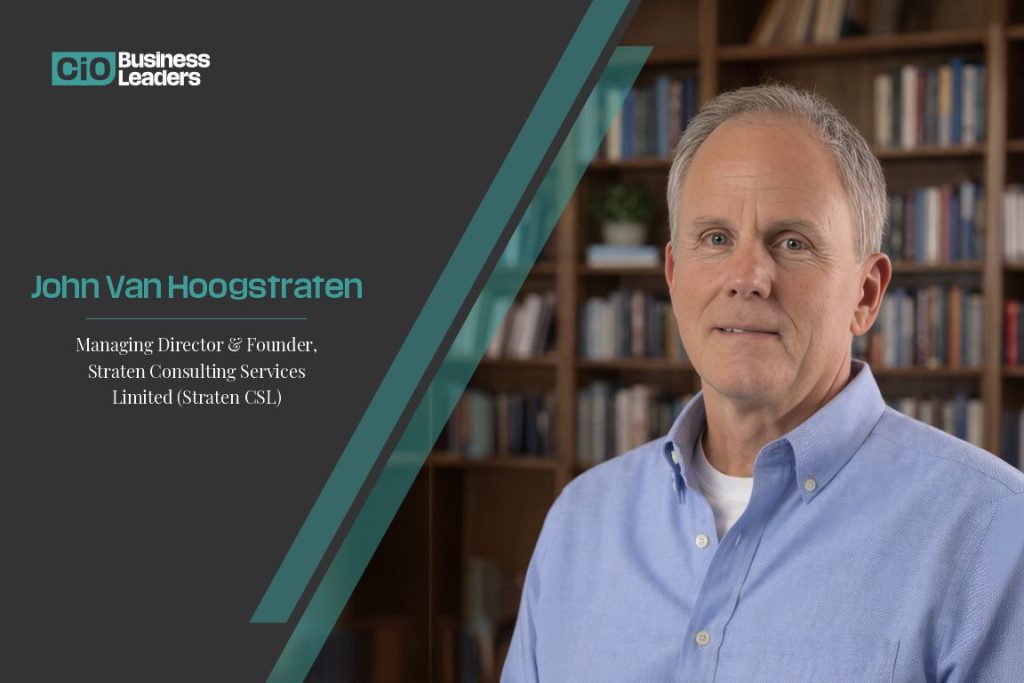
John Van Hoogstraten is Managing Director and Founder of Straten Consulting Services Limited (Straten CSL) (www.stratencsl.com), an international aviation consultancy specializing in ATM, airspace, airports, surveillance, safety, and renewable-energy aviation.
His career began in air traffic control in South Africa and spans almost four decades, including senior operational, management, and safety roles in South Africa and the UAE. That journey shapes his perspective on automation, AI, and the future role of the controller.
From the Control Room to the Boardroom
John’s route into leadership was not through business school, but in an air traffic control room in South Africa, where responsibility came early, decisions had consequences, information was rarely perfect, and outcomes depended on teams working together while retaining clear individual accountability. Over four decades, he progressed from operational control into senior operational, management, and safety roles in South Africa and the UAE.
“What shaped me most was seeing the difference between managing a system and leading people within it. In aviation, procedures and technology are essential, but neither replaces judgement, trust, communication, or professional competence. I carried that lesson into business,” he recalls.
John’s interest in management grew from operational necessity: understanding why some organizations adapt while others struggle, why good ideas fail in implementation, and how leaders create an environment where specialists are trusted to challenge assumptions. “Those questions became central to the way I lead Straten CSL today,” he remarks.
Founding a Consultancy Rooted in Operations
Straten CSL grew from a simple observation: aviation consultancy needed a business rooted in operational reality. After years in ATC, ATM management and aviation safety, John had seen excellent technology and well-intentioned programs fail to translate into operations. “I wanted to create a consultancy that could bridge that gap: technically informed, but operationally led,” he reflects.
Founded in 2021, Straten CSL has become an international specialist aviation consultancy working across ATM, airspace, airport development, instrument flight procedures, CNS systems, safety assurance, aviation safeguarding, and the interaction between aviation and major infrastructure, including renewable energy.
The decision also reshaped John’s professional journey. Instead of responsibility for one organization or one part of an aviation system, he now works across countries, regulatory environments, and sectors, reinforcing his belief that aviation problems are rarely solved well through a single technical discipline.
Straten CSL is extending its international footprint into South Africa, returning to where John’s aviation career began, bringing international experience to a growing African aviation and renewable-energy market.
Credibility Earned in the Operation
The factor that most influenced John’s leadership style was operational air traffic control itself. A controller cannot lead through status alone; credibility comes from competence, calmness, consistency, and the willingness to make decisions when required.
Equally, the safest controller is not the one who believes they’re always right, but the one who listens, remains receptive to challenge, and recognizes when a teammate sees something they do not. That philosophy stayed with John as he moved into senior management and safety assurance. It also shaped his view of technology.
“I try to create the same culture at Straten CSL: give capable people responsibility, make the objective clear, encourage professional challenge, and avoid unnecessary hierarchy,” he affirms. “Too many transformation programs begin with: What can the technology do? I prefer to begin with: What operational problem are we trying to solve? Technology should enable the operation, not define it.”
“Technology should enable the operation, not define it.”
Protecting the Quality of Thinking
As Managing Director, John both leads Straten CSL and protects the quality of its thinking. He sets strategic direction, develops partnerships, maintains key client relationships, and ensures growth without losing the specialist character that made the business valuable. He also remains technically engaged in major ATM, airspace, airport, and renewable-energy aviation projects, noting that resilience comes from not depending on one market or one service.
Straten CSL works across airports, airspace, ATM, instrument flight procedures, safety, CNS, safeguarding, wind and solar development, and international aviation advisory work, connected by a common foundation: understanding how aviation actually operates. It also partners with specialists where it serves the client better, rather than building every capability internally, keeping the firm agile while delivering complex multidisciplinary work.
Straten CSL’s international growth follows the same principle. The UK remains a key base, but its work increasingly spans Europe, the Middle East, and Africa, while the US is becoming a particularly interesting market as its air traffic system enters a major period of modernization.
Discipline Before Technology
For John, Straten CSL’s main differentiator isn’t a single technology; it’s the way it frames the problem. In aviation, particularly around surveillance, airports, and renewable-energy development, there’s a tendency to identify a technical effect and immediately treat it as an operational or safety problem.
Straten CSL takes a more disciplined approach: establish the technical effect, understand the actual operational exposure, determine the operational consequence, assess the safety risk, and identify proportionate mitigation where it’s genuinely required.
“That distinction is important,” John insists. “A radar line-of-sight result, for example, tells you something about geometry. It does not by itself tell you whether air traffic operations are materially affected.”
Straten CSL applies the same thinking to ATM transformation, combining operational ATC experience with airspace, surveillance, safety, and engineering knowledge so that technology is assessed in the context where controllers and pilots will actually use it.
The company has also invested in specialist modelling and analytical capability, including radar coverage analysis, airspace and traffic analysis, fast-time simulation, and instrument flight procedure expertise. “But the tools support the judgement; they don’t replace it,” John clarifies.
Which Cognitive Tasks Remain Human
John sees ATM’s biggest shift as moving from controlling individual infrastructure to managing a connected information environment.
He predicts the controller’s role will evolve through cooperative surveillance, richer aircraft-derived data, trajectory-based operations, increased automation, AI-assisted decision support, and more integrated airspace management. New users, including uncrewed aircraft and advanced air mobility, will add complexity.
“I don’t see that as simply replacing controllers with automation,” he says. “The more interesting question is which cognitive tasks should remain human, which can be supported or automated, and how we maintain resilience when interconnected systems fail.”
US air traffic modernization makes this timely, offering a chance not just to replace aging equipment, but to rethink how technology, airspace design, people, and operational decision-making relate.
“International experience offers useful lessons, but each system must develop solutions suited to its own environment,” John insists. “In Africa, the challenge differs in scale and maturity but is similar in principle: building interoperable, resilient, digital ATM systems while supporting growth.”
Straten CSL is preparing by strengthening its airspace, surveillance, IFP, simulation, and safety capability, plus international partnerships, and the operational perspective that connects them.
Better Questions, Not Fixed Answers
John hopes his contribution is less about promoting a particular solution than encouraging better questions. As ATM enters one of its most significant periods of change, automation, AI, trajectory-based operations, digital information, cooperative surveillance, and increasingly capable decision-support systems will reshape what controllers do and how airspace is managed.
“The danger is assuming that technological capability automatically equals operational progress,” he cautions. John’s second book, ‘From Control to Cognition,’ explores the changing relationship between the human operator and increasingly intelligent systems.
Tomorrow’s ATM leaders must understand both technology and human performance, and be comfortable with automation while remaining alert to judgement, resilience, and operational accountability.
John hopes that his work encourages future leaders to remain curious, challenge fashionable assumptions, and remember that transformation succeeds when people, procedures, technology, and operational purpose evolve together.
“The future of ATM is not a choice between people and automation. It is about designing the right relationship between them.”
From Operator to Architect of the Debate
The career milestone John values most is his transition from an operational controller responsible for traffic to influencing how aviation systems are designed, assessed, and improved.
Having served in senior ATC roles in South Africa and the UAE, managed aviation safety and assurance activities, and worked internationally across complex ATM and airspace environments, he gained the confidence to establish Straten CSL and build something independent.
Publishing ‘Reclaiming the Skies’ in 2025 and ‘From Control to Cognition’ in 2026 was another important step. Writing forced John to articulate ideas developed over decades of operational experience: how ATM should evolve, how technology changes the nature of control, and why the human dimension must remain central to transformation.
“The success I value is not a single award. It’s having moved from operating within the system to contributing to the debate about what the system should become,” he emphasizes.
Knowing When Not to Control
John’s biggest challenge as Managing Director has been learning when not to behave like an air traffic controller. Controllers are trained to take ownership, process information quickly, and resolve problems – an invaluable operational skill that can become a limitation when building a company.
A growing consultancy can’t depend on one person making every decision, so John delegates, collaborates, and creates structures that let other specialists lead, accepting that someone else may approach a problem differently, and that “different doesn’t mean wrong.”
His second challenge is maintaining independence while growing. Consultancy can easily bend toward what a client hopes to hear, but credibility comes from honesty – harder in the short term, but it builds stronger relationships.
Finally, international growth requires patience. Markets differ in regulatory culture, procurement, and expectations. Straten CSL builds credible local relationships rather than exporting a model developed in one country to another.
“A technical effect is not automatically an operational impact, and an operational impact is not automatically a safety risk.”
Leadership Is Not Being the Busiest
John notes that balance and sustained performance require perspective. Aviation and operational ATC can breed permanent availability and constant urgency, which can overflow into running a consultancy.
He distinguishes what’s genuinely urgent and what’s simply demanding attention, delegates more than before, protects time for thinking and writing, and maintains interests and relationships outside the business.
Writing helps him step away from immediate project pressures and reflect on the industry’s larger direction. “I don’t believe leadership is demonstrated by being the busiest person in the organization. A leader who’s permanently overloaded eventually becomes a constraint on the people around them,” he observes.
Evidence Before Objection
For Straten CSL, sustainability and aviation safety are not competing principles. Its work with wind and solar developers illustrates this: while the transition to renewable energy is necessary, developments can interact with radar, airspace, airports, flight procedures, and aviation operations.
“The answer shouldn’t be to assume aviation must always object, nor that renewable development should automatically take precedence,” John observes. “Our role is to establish the evidence, understand the real operational consequence, and identify proportionate solutions.”
That philosophy extends to Straten CSL’s wider work as an ethical consultancy: remain independent, be clear about uncertainty, and don’t manufacture a problem simply to create more consultancy work.
“I believe good professional advice should enable development where it can safely be accommodated and identify genuine constraints where it cannot. That balance is important both commercially and societally,” John clarifies.
Constructive Challenge, Grounded in Evidence
John hopes his legacy is one of “constructive challenge.” Aviation is rightly conservative about safety, but that shouldn’t become resistance to evidence or change, nor should enthusiasm for new technology discard operational knowledge just because something newer has arrived.
“I hope my work, books, and Straten CSL itself contribute to a culture where those two perspectives coexist: ambitious about modernization, but disciplined about how it’s introduced,” he explains.
For Straten CSL, John hopes to build a company that outlasts its founder: internationally respected, independent in its advice, technically capable, and still close enough to operations to understand the consequences of what it recommends.
On a personal level, if younger aviation professionals can question established thinking respectfully and use evidence rather than hierarchy to advance an argument, he considers that a worthwhile legacy.
Competence Before Recognition
John’s advice for aspiring leaders who want to make a lasting impact is to become very good at something before becoming preoccupied with being recognized for it.
Leadership has far more substance when built on genuine competence and experience. Stay curious. Listen to people who understand the details. Be prepared to change your mind when the evidence changes, and don’t confuse confidence with certainty.
He also encourages leaders to understand the problem before becoming attached to the solution. Many organizations do the opposite, falling in love with a technology, process, or strategy before looking for a problem that justifies it.
Finally, build teams in which people can disagree with you. If everyone around the table thinks the same way, leadership becomes an echo chamber. “The best leaders I’ve worked with created clarity without pretending to have every answer. That’s the kind of leadership I continue to aim for,” John concludes.
“Understand the problem before becoming attached to the solution.”
Conclusion
John Van Hoogstraten’s career has moved from operating within the aviation system to shaping the debate about what it should become. Through Straten CSL, his books, and his advisory work, he argues for modernization that is ambitious but disciplined, technology that enables the operation rather than defines it, and leadership built on competence rather than status.