




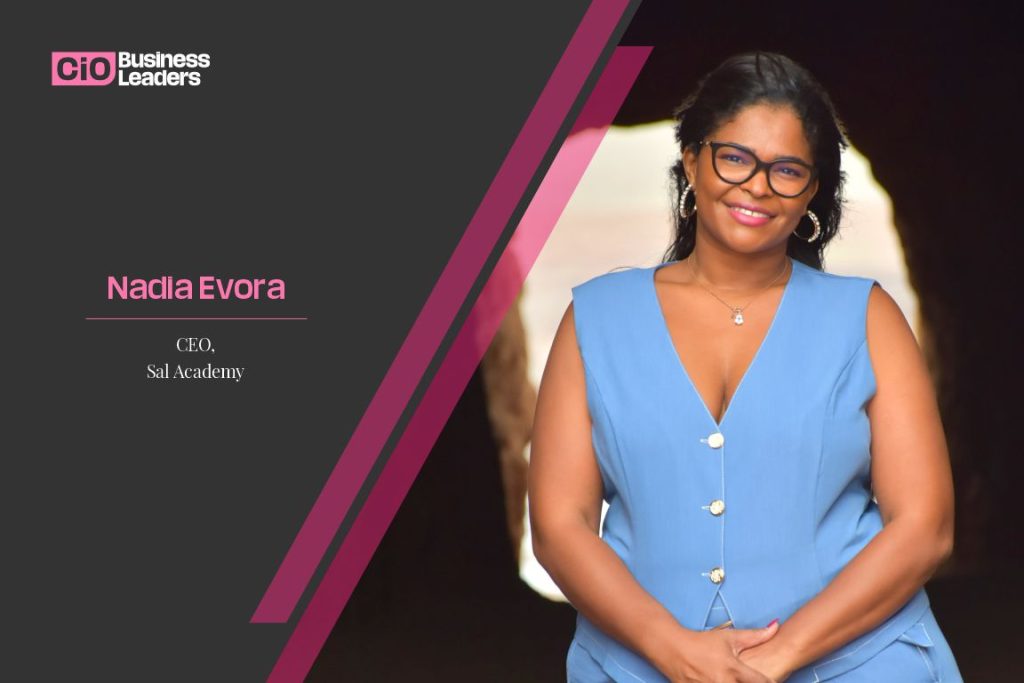
Nadia Evora is the founder and CEO of Sal Academy, a leading vocational training institution in Cabo Verde focused on transforming talent into opportunity. Under her leadership, the Academy has become a national reference in professional training, partnerships, and certification. It is also recognised for its human-centred approach.
As CEO, Nadia ensures that Sal Academy’s focus is not confined to just training professionals. It shapes leaders, dreamers, and agents of transformation capable of elevating their communities and country. Her aim is to contribute lasting improvements to the national educational ecosystem through innovative methodologies, international partnerships that broaden horizons, fairer certification structures, and a management model that proves education can be modern, efficient, and deeply human at the same time. Nadia wants to be remembered as someone who served the country through education.
Belief in the Power of Education
Education, Nadia believes, is the most “powerful instrument” for social, economic, and human transformation. This belief is what put her on the educational leadership path in the first place. Early on, she also understood that talent exists in abundance, but opportunities do not always follow. “This reality always unsettled me,” she says, “and simultaneously propelled me forward.”
“I saw in education, particularly in vocational training, a concrete way to change realities, open doors, and create social mobility,” she adds. At Sal Academy, Nadia saw an ideal platform to bring this vision to life, as it brings together three key elements: the freedom to innovate, proximity to the community, and direct impact on the lives of trainees.
According to her, from the beginning, she was confident that she could build something greater than a training centre. She wanted to create a learning ecosystem where both young people and adults discover themselves, gain skills, and project themselves into the future.
When she took the reins of leadership, Nadia committed to transforming the Academy into a space of excellence, where quality, rigour, and humanity walk hand in hand. “Sal Academy allowed me to unite my passion for education, management experience, and the purpose of developing skills that truly change life trajectories,” she says. Every course launched, partnership built, and trainee who carves a path forward reinforces that this is, indeed, the platform where she can exercise meaningful leadership.
“Ultimately, it was my belief that Africa, and Cabo Verde, can develop extraordinary leaders that brought me to this mission,” Nadia says, “and it is Sal Academy that allows me, every day, to turn that belief into reality.”
Currently, Sal Academy is in the funding stage for building its new headquarters. Nadia says they envision it as a Human Development Centre for Sal Island, Cabo Verde, and the world.
Guardian of Educational Mission
As CEO, Nadia sees herself as the guardian of their educational mission and a catalyst for real impact. She believes that education and entrepreneurship have the power to transform realities. This is why she has made it her life’s mission.
“Leading Sal Academy means working every day to unlock potential, create opportunities, and prepare talent that will contribute to the development of our country and our continent,” Nadia says.
She also points out that the CEO role, in such a dynamic sector, requires balancing three essential fronts. The first is strategic vision. It involves setting clear directions for where they want to be in the next 5 to 10 years, anticipating trends, and positioning the institution at the forefront of educational innovation.
The second front is pedagogical excellence. Nadia has to ensure that their courses are relevant, aligned with the market, and able to develop real competencies, always focused on employability and professional impact. And the third front is human-centred leadership. According to Nadia, it means creating an environment where trainees, trainers, and staff feel valued, motivated, and empowered to thrive. “Learning flourishes where there is respect, inclusion, and purpose,” she says.
Nadia’s decisions are always guided by their “end trainee”: what they need to learn, the kind of professional they will become, and the opportunities they will have upon completing their training. Additionally, as CEO, she works to strengthen solid administrative processes and structures that allow them to scale without compromising quality.
Most Transformative Challenge
Nadia’s success story is dotted with challenges. As a woman CEO in Africa’s education sector, the most transformative challenge she encountered was asserting her leadership in environments where women’s authority is still frequently tested. She explains that a woman leader’s competence is rarely questioned. However, she often has to deal with cultural resistance, initial distrust, and the constant need to prove her credibility in spaces historically not designed for women.
“My greatest challenge was overcoming stereotypes and gaining institutional recognition, especially in negotiations with public and private partners,” Nadia recalls. There were moments when she had to prove the same competence twice, while her male colleagues only had to prove it once. She found this exhaustive as well as transformative. From this experience, she learned to build solid evidence, such as reports, performance indicators, student results, and strategic partnerships. It ensured that her credibility was unquestionable.
“Over time, I realised that each barrier overcome was not just a personal victory, but a pathway opened for other women,” Nadia says. This process strengthened her leadership style. She became more strategic, resilient, and intentional in how she represents her organisation. And today, the evidence they have built serves as leverage for other women on their team and female students. It shows that merit, consistency, and results speak louder than stereotypes.
“In the end, what seemed like an obstacle became a powerful school of courage and purpose,” Nadia says. “It shaped me into a leader more aware of the impact she can create, not only in education, but in shifting narratives about women’s leadership in Africa.”
Achievement: Consolidation of Sal Academy
Consolidating Sal Academy as a national reference institution is one of the most defining moments in Nadia’s career. Today, the Academy influences public policy, sets standards in vocational training, and transforms lives through qualification.
“This milestone was not only an organisational success, but also the validation of a vision I always believed in,” Nadia says. “That quality education can be a driver of social mobility and economic development in Cabo Verde.”
She recalls that building a “solid academy,” recognised by public and private partners, was a demanding and transformative process. It required consistency, technical rigour, and courage to innovate. They introduced pioneering programmes and international methodologies, developed training aligned with market needs, and continuously invested in the upskilling of trainers. At the same time, Nadia and her team had constant dialogue with regulatory entities, institutional partners, and companies. These conversations helped establish the credibility of vocational education in the country.
“What makes this achievement truly defining is its human impact,” Nadia says. When she saw young people secure their first job, adults regain confidence and advance in their careers, and teams grow, women lead, and professionals thrive thanks to training, it brought a renewed sense of purpose to her leadership.
At the same time, Nadia has taken on strategic leadership roles of significant impact: she is CEO of Sal Consulting, Vice President of ANECPCV, RVCC Coordinator on the island of Sal, a member of the Advisory Board of the CCB, as well as an international mentor, consultant, and trainer. Each of these roles has expanded her ability to positively influence the educational and business ecosystem. Nevertheless, she never forgets that it all began with the solid foundation built at Sal Academy.
“This is why this achievement is a defining moment,” Nadia says. “It marked the transition from operational leadership to systemic leadership, locally, nationally, and internationally.” It was also the moment she understood that her work could also transform people, communities, and entire futures.
Influence of Personal Experiences
Nadia’s leadership style is shaped by personal values, demanding professional experiences, and a journey marked by continuous learning. She grew up in an environment that valued responsibility, resilience, and honest work. According to her, she learned early on that consistent results arise when there is discipline, ethics, and respect for people. “This foundation shaped how I lead,” she says. “I prioritise transparency, clarity, and a shared sense of purpose within my teams.”
Another defining experience was her path in training and skills development, where she worked daily with people from diverse realities. While engaging with young people starting their careers, professionals in transition, and teams facing real operational challenges, she learned the importance of empathy and active listening. “Today, my decisions always seek to consider human impact, not just technical indicators,” Nadia says.
She also remembers the moments when she had to take on major responsibilities, often with limited resources or demanding deadlines. These situations strengthened her ability to prioritise, take calculated risks, and maintain composure under pressure. She believes that a leader gains credibility when they demonstrate balance and coherence during the most challenging moments.
And Nadia’s international experiences and exposure to multicultural environments broadened her strategic vision and reinforced her trust in collaborative processes. “I learned that the best solutions emerge when we include diverse perspectives and encourage creativity and autonomy within teams,” she says.
Initiatives with Long-Term Impact Potential
Nadia has consistently sought to lead initiatives that go beyond immediate results, focusing on actions that plant the seeds of lasting transformation. Among those with the greatest long-term impact are the launch of professional training programmes in the tourism sector and its value chain, based on higher pedagogical standards, strong practical components, real internships, and direct links to employers.
She also led a study supporting the implementation of the Professional Card, which resulted in concrete recommendations and amendments to the legal framework governing the Recognition, Validation and Certification of Competences (RVCC). This progress enabled around 700 professionals to gain formal recognition of lifelong competences, professional certification, and improved career prospects.
Nadia further promoted inclusive, practice-oriented methodologies aligned with labour market needs, especially for young people with fewer opportunities. In partnership with the Ministry of Education, Sal Academy will lead a Pilot Educational Recovery Programme, running alongside professional training, allowing early school leavers to obtain dual academic and professional certification.
The construction of Sal Academy’s headquarters, with capacity for 300 trainees per period and 600–800 annually, strengthens scale, quality, and sustainability. Together, these initiatives build structures, raise standards, and create lasting social and economic impact.
Advice for Young Women
“Don’t wait for external validation to take their place” is Nadia’s advice to young women aspiring to lead in education or male-dominated sectors. She encourages them to build their competence and move forward with courage, even when the environment suggests they should step back.
She also advises them to understand that leadership is not born from fearlessness, but from the decision to advance despite fear. “Seek training, seek mentors, seek networks of women who have walked this path,” she adds. “Every solid learning you acquire becomes a tool no one can take away from you.”
Additionally, she tells young women to never conform to narratives that diminish their worth. She explains that structures may still be used to see men in decision-making spaces, but that does not mean women need to fit those patterns. “On the contrary: bring your vision, leadership style, strategic sensitivity,” Nadia says. “Diversity of perspectives is what transforms institutions and sectors.” She also reminds them that leadership does not mean doing everything alone. She wants them to build strong teams, learn to delegate, and create alliances.
“And don’t forget: by claiming your space, you are also opening doors for those who come after you,” Nadia says.
She hopes that every young woman understands she does not need permission to lead. ‘She only needs competence, courage, and awareness of the impact she can generate,” she says.
The Legacy!
Nadia aspires to build a movement of educational and social transformation that outlives her presence and continues to generate impact for generations to come. For Sal Academy, her vision is to establish it as an institution that elevates the standard of vocational training in Cabo Verde. She hopes it will be known for creating real opportunities, shaping talent with purpose, and dignifying often overlooked careers.
“I want the Academy to be remembered as a space where anyone, regardless of background, found open doors, support, high standards, and the possibility to rewrite their story,” Nadia says.
Additionally, she wants to be remembered for visible, transformative female leadership. She hopes her journey will inspire other women to run institutions, occupy decision-making spaces, and influence public policies. “If, by looking at my path, other women gain courage to advance, then my impact has already been meaningful,” Nadia says.
What Is an Inspiring CEO?
In today’s Africa, Nadia views being an “inspiring CEO” as recognising that one leads in a young, creative continent full of potential, but still marked by structural inequalities, gender barriers, and resource limitations. “To inspire in this scenario requires courage, authenticity, and a commitment to social transformation, along with strategic vision,” she says.
For her, being an inspiring CEO also means leading by example and making transparent, ethical, and impact-oriented decisions. It shows that it is possible to grow, innovate, and transform the education sector without losing humanity. And an inspiring CEO also creates opportunities, develops female talent, supports young leaders, and builds spaces where every person feels seen, valued, and capable of growing, according to Nadia.
“Inspiring leadership is not measured only by what one achieves individually,” she adds, “but by what one ignites and multiplies in others.”